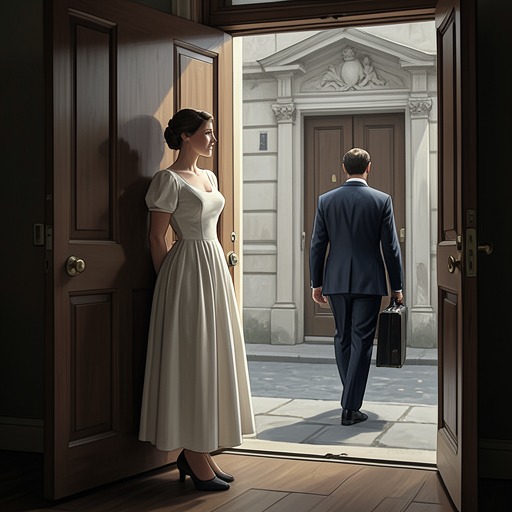
Sarah and Downey's escape by train
Down Cemetery RoadSarah and Michael Downey’s escape by train turns a violent flight from Sarah’s house into a journey whose apparent direction keeps changing. Sarah has almost no money, no settled plan, and little capacity to choose; Downey, meanwhile, removes the evidence of the killing as they go. Their departure is therefore both a practical escape and a rupture in Sarah’s former life, sharpened by an unexpected sight at the station: Mark Trafford with another woman.
Flight from the house
Before they reach the station, Downey disposes of the gun, its silencer, and its ammunition in three separate drains between the house and the railway. He does it fluidly, without an obvious stumble, so that an observer might mistake the act for a mime. The care with which he conceals the weapon contrasts with the confusion of Sarah’s situation. Her best friend’s husband has tried to kill her; the frightening stranger she has regarded as a bogeyman has shot him. Sarah has taken only her wallet, which holds a little over twenty pounds, and feels that circumstance, rather than a decision of her own, is carrying her forward.
Their route to the station runs first through darkness: along the river, over the old railway bridge, and across a meadow beside the ice rink. Through its windows Sarah can see a few late skaters tracing figure eights. The route then opens onto a brightly lit main road, where cars pass, neon from a garage spills across oily puddles, and teenagers head towards a nightclub. These ordinary signs of a city continuing around them make the flight feel less like a planned operation than a passage through a world Sarah can no longer inhabit normally.
The station stands uphill, and its fluorescent light seems to promise safety. As Sarah arrives, the effort catches up with her in an ache in her calves. Downey removes his hand from her elbow, leaving her a choice of where to go. The small gesture briefly gives her agency, but the choice is made under the pressure of recent violence and fear. The escape begins not with a clear objective, but with a few steps taken away from the house.
The station and the broken marriage
At the station Sarah sees Mark kissing a woman she has never met. The kiss is brief and almost perfunctory, but the woman holds Mark’s arm, and their intimacy is unmistakable to Sarah. The discovery settles into her consciousness as the knowledge that Mark has a lover. After the violence of the preceding hour, the revelation does not produce a new crisis so much as another layer of exhaustion: even this familiar part of her life has become something she did not know.
Mark straightens, exchanges a few final endearments with the woman, and heads towards the stairs. Sarah might have stayed to meet him. Instead, Downey appears beside her and presses what looks like a twenty-pound note into her hand, telling her there are two return tickets to Worcester and that the train leaves in two minutes. She moves quickly through the ticket booth. The urgency turns the note into an immediate instruction: there is no time to decide what the journey means before she is already taking it.
On her way back out, Sarah passes Mark at close range. He keeps walking as if she were not there, or were someone else. For a moment she wants to reach for him, as though touch could restore the earlier days when they met trains together and made a spectacle of themselves on the platform. That remembered intimacy stands against the kitchen bodies, arguments, and lovers that now define what she is leaving. Sarah stops and turns, but Mark has gone through the doors and down towards the taxi rank. Downey takes her arm and steers her out before she can call after him.
The slow train
They board a slow train at Platform 3, a short string of grubby carriages with mostly empty compartments, and take one near the rear. Its departure is not dramatic: the train grinds and crawls away, then gathers speed. No one makes a last-minute attempt to stop them. The unheroic pace suits the character of their escape, which depends less on a decisive plan than on the absence, for the moment, of anyone able to prevent it.
As the platform slips away, Sarah sees her pale reflection in the window and thinks of bodies: the warm bodies of unfaithful husbands and the cold body left in the kitchen. She wipes a hand against the glass. Outside, hedgerows appear as ragged stumps; clouds swallow the evening, and fields and ditches blur into a bleak horizon. Sarah imagines the thin red necklace of the cord that nearly strangled her, while telling Downey that she had said it was not a matter of life and death. He does not understand the remark. The image makes the escape’s immediate stakes bodily and intimate, even as the landscape makes the distance from home seem to expand.
The journey is later described as an improvised flight rather than a strategy: it lacks preparation, forethought, and a definite objective. Downey has bought two single tickets to Birmingham and covered their tracks while they ran. He has also let down his ponytail, allowing his dark hair to fall over his face and shoulders, and speaks in a strained, hoarse voice. During the journey he asks Sarah whether she was on the bridge after they killed Tom; she confirms that she was. The question connects their escape to the earlier killing without turning their shared flight into an explanation or resolution of it.
Malvern and the return
Sarah leaves the train at Malvern. There are no whistles or alarms, and she sees no sign of Downey. She waits until the train has pulled away before leaving the platform, watching the departure as the closing of an escape route. She has only a fistful of money and is dressed in jeans, a T-shirt, and a thin cotton top. She has never been to Malvern; its neat, well-kept appearance offers little comfort under the platform lights, which fall in pools surrounded by shifting shadows.
At first, Sarah accepts that Downey has abandoned her. He is a stranger who saved her life and, she reasons, owes her nothing. She can imagine him somewhere far away, though she cannot know where he has gone. Sounds of thumping, heaving, and laughter come from beyond the shadows. Cold and fear return together with the memory of the noose tightening around her throat, and her instinct for self-preservation tells her to find somewhere brighter, busier, and warmer.
Downey reappears with his hair cut on the train. His changed appearance distracts Sarah from her fright only briefly; anger comes out in a coarse rebuke, while relief is present beneath it. He asks who else nearby knows her name. Their exchange leaves the flight unresolved: the train has taken Sarah away from the house and Mark, but it has not given her a safe destination or a dependable companion. Its decisive change is narrower and more immediate. Sarah has been carried out of a life she thought she could still return to, and into a precarious movement whose next step remains uncertain.